Vrije Universiteit Brussel
The importance of electricity in our society
Allegorical symbolismThe importance of electricity in our society is illustrated in the allegorical image above, a symbolic representation in which an abstract concept such as electricity is depicted by mythical figures. The image depicts three figures:
The trio depicted thus exemplifies the various applications of electrical energy and illustrates the importance of electricity in our society. This illustration was taken from The Central Station, an American electrical engineering journal from the early twentieth century. It is an example of a mixed-gender allegory in which both sexes are depicted. It is true that one might argue that such allegories are old-fashioned relics from a bygone era, no longer fitting within the framework of modern communication; on the other hand, it is true that the main applications of electricity in our society symbolised in the image (lighting, propulsion and data transmission) are still relevant today, and that their symbolism therefore remains as valid as ever. Moreover, the image contains a number of aspects that are surprisingly relevant to our times; for instance, the mixed-gender character serves as a model for diversity which is considered very important today .It can therefore be argued that, after more than a hundred years, this image still possesses the potential to represent electrical engineering in a multidisciplinary, diverse and socially relevant manner. It makes use of a timeless mythological imagery to illustrate the importance of electricity in our society and its contribution to general social well-being. It therefore represents a broad cultural approach to electricity, and affirms the electrical engineer as an intellectual who bears a great social responsibility that transcends the purely techno-economic, and is thus a fitting symbol for ETEC. ETEC's vision on engineering educationETEC offers its Electrical Engineering students a versatile and engaging programme with extensive career opportunities across various sectors: industry, services and the public sector. ETEC's rich research tradition in the field of electric vehicles has led to the introduction of a specific curriculum in transport technology, covering both conventional and alternative propulsion systems in the context of global transport and environmental policy. This specific programme is ideally suited to addressing current societal challenges.
Thanks to many years of experience in education, research and service provision, ETEC has been able to develop a well-founded vision of its primary task: the training of engineers. On the one hand, it is clear that engineering education, not least through its research activities, must always be at the forefront of technological development, in order to immerse students in a scientific and high-tech environment that inspires scientific research and which is intellectually enriching. ETEC has therefore always focused on new technological developments, such as electric vehicles. On the other hand, ETEC is aware that the strength of engineering education at Belgian universities largely rests on the versatility of the engineer, who, as a generalist par excellence, to tackle a wide variety of problems and is thus able to apply their skills in a wide variety of situations and in a wide variety of roles, thereby contributing to the general welfare of society. This applies both to the theoretically oriented civil engineer and to the practically oriented industrial engineer. ETEC will therefore offer its students the broadest possible education as part of a general scientific and technical engineering culture, whilst also paying attention to the social responsibility of the engineer as an intellectual. In summary, it can be said that ETEC, partly in view of the broad societal relevance of its field, offers an ideal educational and research environment for training the engineers of tomorrow. |
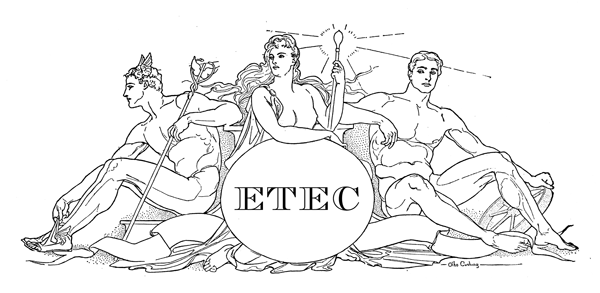 Based on: "The Central Station", H.C. Cushing, Jr., New York
©2007-2026 • Vrije Universiteit Brussel • Department ETEC • Pleinlaan 2 • B-1050 Elsene • 02/6292804 • eleloup@vub.ac.be